In this article
"The Nebenkostenabrechnung is an annual stress factor for many landlords — yet the majority of problems can be avoided through structured preparation and knowledge of the legal requirements."
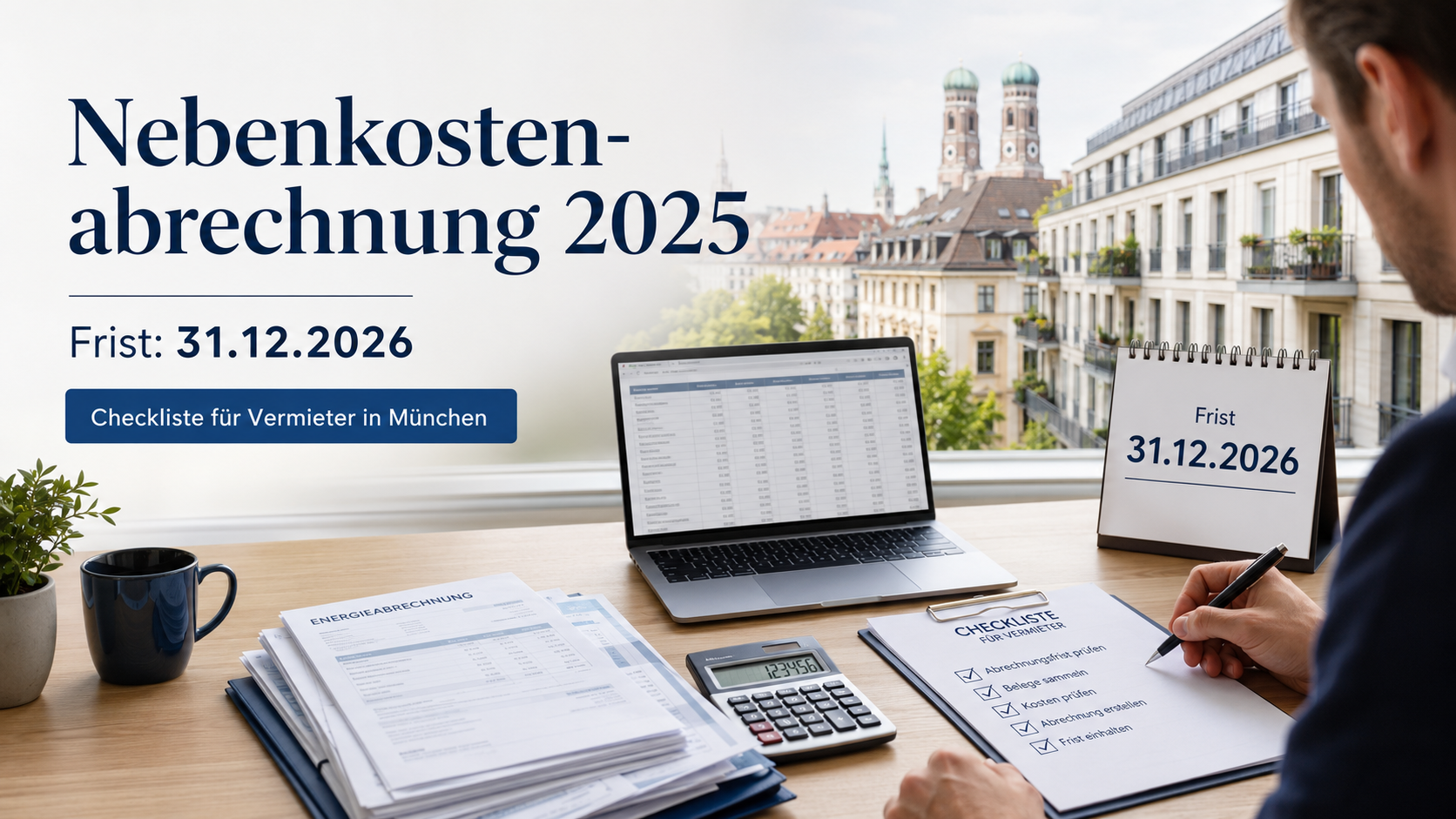
The operating cost statement (Nebenkostenabrechnung) for 2025 must reach tenants in Germany by 31 December 2026 at the latest. Landlords who miss this deadline lose the right to back-charge — even if actual costs exceeded the advance payments made.
In Munich, this is especially relevant: with high energy costs, rising property taxes and complex WEG statements in multi-family buildings, discrepancies between advance payments and actual costs are common.
The legal deadline – what happens if you miss it?
Under § 556 para. 3 BGB, the operating cost statement must reach the tenant within 12 months of the end of the billing period. For the 2025 billing year this means: the deadline is 31 December 2026.
What happens if the deadline is missed?
- Back-charges against the tenant are no longer enforceable
- This applies even if the landlord actually incurred higher costs
- Any tenant credit balance must still be paid out
- Exception: landlord was not responsible for the delay (e.g. late WEG statement)
Important: the statement must have reached the tenant — not merely been sent. For postal delivery, a recorded delivery letter or personal acknowledgement is recommended.
What must the statement contain?
A formally correct operating cost statement must include at minimum the following, per BGH case law:
- Summary of total costs per cost item
- Distribution key stated and explained
- Calculation of the tenant's share
- Deduction of advance payments made
- Clear identification of the billing period
If any of these elements is missing, the statement is formally invalid — the tenant has no obligation to pay, even if the costs are correct.
Recoverable vs. non-recoverable costs
Not all costs incurred by a landlord may be passed on to tenants. The Betriebskostenverordnung (BetrKV) exhaustively defines which items are recoverable.
| Cost item | Recoverable | Note |
|---|---|---|
| Heating / hot water | ✓ Yes | At least 50–70% must be consumption-based |
| Cold water / sewage | ✓ Yes | By consumption or number of persons |
| Refuse collection | ✓ Yes | Per local authority schedule |
| Caretaker / janitor | ✓ Yes | Operational costs only, not admin |
| Building insurance | ✓ Yes | Liability, fire, water damage |
| Property tax (Grundsteuer) | ✓ Yes | Increased in Munich from 2025 |
| Lift (operation & maintenance) | ✓ Yes | Including ground-floor tenants |
| Garden maintenance | ✓ Yes | If agreed in tenancy agreement |
| Management costs | ✗ No | Borne by landlord |
| Maintenance / repairs | ✗ No | Exception: minor repairs clause |
| Vacancy costs | ✗ No | Landlord bears costs for empty units |
| Account management fees | ✗ No | Pure administration costs |
The most common mistakes
1. Incorrect or missing distribution key
The distribution key must be clearly named and agreed in the tenancy agreement. If distributing by floor area, the total areas must be stated correctly. An incorrect key makes the entire statement open to challenge.
2. Non-recoverable costs included
Management costs, maintenance or repair costs are frequently included by mistake. Tenants can then contest individual items — or the entire statement.
3. Heating costs not billed on a consumption basis
For central heating, the Heizkostenverordnung applies: at least 50%, maximum 70% of heating costs must be billed on a consumption basis. Billing purely by area risks a 15% reduction.
4. Receipts not retained
Tenants have the right to inspect receipts. Landlords should retain all invoices, contracts and statements for at least 3 years — preferably 5 years to be prepared for any disputes.
5. Munich 2025 property tax increase not correctly included
Munich increased the Grundsteuer B multiplier in 2025. Landlords who have not correctly reflected this may be underestimating actual costs.
Checklist for Munich landlords 2025
✓ Your operating cost statement checklist
- Deadline 31.12.2026 noted in calendar
- All invoices and receipts for 2025 collected and organised
- Tenancy agreement checked for agreed operating cost items
- Distribution key clearly defined for each cost item
- Total floor area of all units (incl. vacant) correctly recorded
- Heating costs at least 50% consumption-based
- Non-recoverable costs (management, repairs) excluded
- Munich Grundsteuer increase 2025 incorporated
- Advance payments fully deducted
- Statement checked for formal completeness
- Delivery to tenant confirmed (recorded post or acknowledgement)
- Receipts archived for at least 3 years
What to do if the tenant objects?
After receiving the statement, tenants have 12 months to raise objections (§ 556 para. 3 sentence 5 BGB). Typical objections include:
- Disputing individual cost items as non-recoverable
- Challenging the distribution key
- Requesting sight of receipts
- Errors in advance payments recorded
In the event of a dispute, a clarifying conversation is recommended first. If receipts are requested, they must be made available for inspection within a reasonable time. For serious conflicts, a tenancy law specialist should be consulted.
Tip for Munich landlords: a professional property manager like mHomes handles the complete operating cost statement — from receipt collection to legally compliant delivery to the tenant.
Outsource your operating cost statement?
mHomes handles the complete Nebenkostenabrechnung for Munich landlords — correct, on time and legally compliant. No stress, no mistakes, no missed deadlines.
Frequently asked questions
This article is for general information purposes and does not constitute individual legal advice. For specific questions about operating cost statements, we recommend consulting a solicitor specialising in tenancy law. All information refers to the current legal position in Germany (as at: June 2026).